2026年苏州科技大学TSP项目国际硕士、博士研究生招生简章(TSP)
2026 TSP Program International Master & PhD Students Enrollment Guide of Suzhou University of Science and Technology(TSP)
一、学校概况 University Profile
苏州科技大学落于素有“人间天堂”之称的历史文化名城苏州,是一所以工为主、多学科协调发展的全日制普通高校。学校设有石湖、江枫、天平三个校区,主校区石湖校区依山傍水、环境清幽。校园占地2300亩,现有全日制本科生23000余人、研究生4400余人(含国际研究生)。学校学科门类齐全,可满足外国留学生本科、硕士、博士不同层次的求学需求。在长期发展过程中,形成了城乡规划学、环境科学与工程、土木工程三大优势学科,连续6年入榜“软科中国最好学科排名”。“工程学”“化学”“材料科学”和“环境生态学”等4个学科进入ESI全球前5‰。学校师资力量雄厚,汇聚了中国科学院院士、发达国家院士、国家“杰青”等国家级、省级高层次人才及高水平团队,其中博士生导师68人、硕士生导师842人,能为外国留学生提供高质量的课堂教学和科研指导服务。学校高度重视国际合作交流,学校先后与30多个国家、地区的100余所高校和研究机构建立了校际合作关系。自1993年以来每年承办由商务部主办的援外人力资源培训班,为130多个“一带一路”沿线国家和发展中国家3000余名环保、能源和物流等领域的官员和技术人员开展培训和学历教育。2015年成为全国首批承担援外硕士学历学位教育项目高校。截至目前,学校已培养硕士层次学历留学生300余名,在校生规模达200人,连续2年获江苏省来华留学生教育先进集体。
Located in Suzhou, a famous historical and cultural city known as the "Paradise on Earth", SUST is a full-time general university focused on engineering with the coordinated development of multiple disciplines. It has three campuses – Shihu, Jiangfeng and Tianping, with the main Shihu Campus nestled in a quiet and beautiful setting surrounded by mountains and waters. Covering an area of 2,300 mu, the university has over 23,000 full-time undergraduates and more than 4,400 postgraduates (including international postgraduates). Boasting a comprehensive range of disciplines, SUST meets the academic needs of international students at undergraduate, master’s and doctoral levels. It has fostered three advantageous disciplines – Urban and Rural Planning, Environmental Science and Engineering, and Civil Engineering – and been listed in the ShanghaiRanking's Best Chinese Disciplines Ranking for six consecutive years. Four disciplines, namely Engineering, Chemistry, Materials Science and Environmental/Ecological Science, have entered the top 5‰ of ESI global rankings. SUST has a strong faculty, gathering high-level talents and teams at national and provincial levels such as members of the Chinese Academy of Sciences, foreign academicians and National Distinguished Young Scholars. With 68 doctoral supervisors and 842 master’s supervisors, it provides high-quality classroom teaching and research guidance for international students. Attaching great importance to international cooperation and exchanges, SUST has established inter-university partnerships with more than 100 universities and research institutions in over 30 countries and regions. Since 1993, it has hosted annual foreign aid human resources training courses sponsored by the Ministry of Commerce of China, training over 3,000 officials and technical personnel in environmental protection, energy, logistics and other fields from more than 130 Belt and Road and developing countries, and offering them academic education. It became one of China’s first universities to undertake foreign aid master’s degree programs in 2015. Up to now, the university has educated over 300 international master’s students, with a current enrollment of 200, and been awarded the Advanced Collective for International Student Education of Jiangsu Province for two consecutive years.
二、申请条件 Application Qualification
1.非中国国籍人士,持有效外国护照。
2.已获得学士学位,有相关专业背景。
3.年龄不超过40岁为佳。
4.身体健康,无中国法律法规禁止入境的疾病。
注:申请人原来为中国公民,后取得外国国籍者,按照国家相关规定审核。
1.Non-Chinese citizen, with foreign passport;
2.Already acquired Bachelor’s Degree of relevant majors;
3.Under the age of 40 is preferred;
4.In good health condition with no major diseases prohibited by Chinese laws and regulations and the University.
Note: Applicants who are former Chinese citizens and have acquired a foreign nationality should be subject to relevant national regulations.
三、招生专业及名额 Programs and Enrollment Plan
培养 层次Education Level |
专业代码 Program Code |
专业名称 Program Name |
教学学院 School |
学制 Study Length |
授课语言 Teaching Language |
招生计划数 Number of Students |
招生联系人及联系方式(电话&邮箱)Consultant |
博士研究生 PhD |
083000 |
环境工程 Environmental Engineering |
环境科学与工程学院 School of Environmental Science and Engineering |
4年 4-Year |
英语 English |
13 |
朱老师/Ms.Likki Likki@usts.edu.cn |
081400 |
土木工程 Civil Engineering |
土木工程学院 School of Civil Engineering |
10 |
吕老师/Ms.LV 245789651@qq.com |
硕士研究生 Master |
0813 |
建筑学 Architecture |
建筑与城市规划学院 School of Architecture and Urban planning |
3年 3-Year |
英语 English |
30 |
黄老师/Ms. Huang 13372170697
1969632702@qq.com |
083001-2 |
环境工程 Environmental Engineering |
环境科学与工程学院 School of Environmental Science and Engineering |
46 |
朱老师/Ms.Likki Likki@usts.edu.cn |
0859 |
土木水利 Civil and Hydraulic Engineering |
土木工程学院 School of Civil Engineering |
12 |
吕老师/Ms.LV 245789651@qq.com |
0812 |
计算机科学与技术 Computer Science and Technology |
电子与信息工程学院 School of Electronic and Information Engineering |
12 |
孙老师/Ms. Sun,15651692723,jwsun@usts.edu.cn |
120100 |
管理科学与工程 Management Science Engineering |
商学院 School of Business |
30 |
谈老师/Mr. Tan
0512-68316573
99852123@qq.com |
0805 |
材料科学与工程 Materials Science and Engineering |
材料科学与工程学院 School of Materials Science and Engineering |
20 |
叶老师/Mr. Ye yechangqing@mail.usts.edu.cn
董老师/Mr. Dong dongyuxiang@usts.edu.cn |
0402 |
心理学 Psychology |
教育学院 School of Education |
30 |
张老师/Ms. Zhang,18913669258 |
注:第1学期为9月-1月,第2学期为2月-6月
Note:1st semester is from September to January ,2nd semester is from February to June.
四、申请材料 Application Documents
硕士 Master:
1.完成苏州科技大学在线申请(https://usts.at0086.cn/student),招生代码一栏请填写TSP。
2. 本科学位、学历证书。中英文以外的文本证书需提供中文或英文翻译件的公证件原件,文件公证件需由中国驻外国使领馆或外国驻华使领馆提供;应届毕业生由本人所在学校出具预计毕业证明原件,如录取,需在报到时携带毕业证书原件验证。
3.学习成绩单复印件。
4.推荐信。曾就读过的学校两名副教授(或者相当职称)以上的推荐信,用中文或英文书写。
5.护照个人信息页。
6.语言水平证明复印件(仅限非英语国家)。
7.HSK成绩报告(如有)。
8.来华学习和研究的中文(或者英文)计划,不少于800字。
1.Fill out the online application system and submit
(Online application :https://usts.at0086.cn/student)Type TSP into Project code and click Submit.
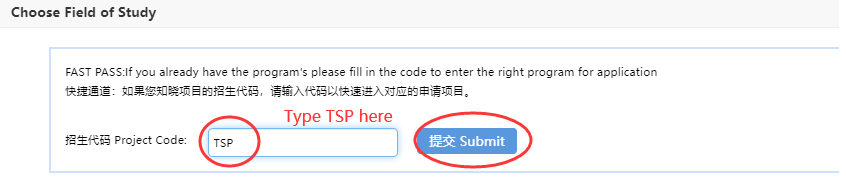
2.Original notarized photocopy of the highest degree proof, including both graduation certificate and degree certificate. Certificates in languages other than Chinese or English must provide a notarized Chinese or English translation. The notarization must be issued by a Chinese embassy or consulate abroad, or by a foreign embassy or consulate in China. For current graduates, an original graduation certificate expected by the school must be provided. If admitted, the original certificate must be brought for verification during the registration process.
3.Academic Transcripts. Documents in languages other than Chinese or English must be attached with notarized translations in Chinese or English;
4.Recommendation letters. Applicants must submit two letters of recommendation in Chinese or English from former college by professors or associate professors;
5.A scanned copy of passport;
6.Photocopy of Language Certificate(students from non-English speaking countries only);
7.HSK (the Chinese Proficiency Test) Certificate (if available);
8.A study or research plan. All applicants are required to submit a study or research plan. It must be in Chinese or in English and no less than 800 words.
博士 PhD:
1.完成苏州科技大学在线申请(https://usts.at0086.cn/student),招生代码一栏请填写TSP-PhD。
2.硕士学位、学历证书。中英文以外的文本证书需提供中文或英文翻译件的公证件原件,文件公证件需由中国驻外国使领馆或外国驻华使领馆提供;应届毕业生由本人所在学校出具预计毕业证明原件,如录取,需在报到时携带毕业证书原件验证。
3.硕士阶段全部课程成绩单原件或公证件。
4.推荐信。曾就读过的学校两名副教授(或者相当职称)以上的推荐信,用中文或英文书写。
5.护照个人信息页。
6.语言水平证明复印件(仅限非英语国家)。
7.HSK成绩报告(如有)。
8.来华学习和研究的中文(或者英文)计划,不少于800字。
9.证明学生学术水平的相关材料,如论文、专利等。
1.Fill out the online application system and submit
(Online application : https://usts.at0086.cn/student) Type TSP-PhD into Project code and click Submit.

2.Master's Degree Certificate. Certificates in languages other than Chinese or English must provide a notarized Chinese or English translation. The notarization must be issued by a Chinese embassy or consulate abroad, or by a foreign embassy or consulate in China.
For current graduates, an original graduation certificate expected by the school must be provided. If admitted, the original certificate must be brought for verification during the registration process.
3.Original or notarized transcript of all courses taken during the Master's program.
4.Recommendation letters. Applicants must submit two letters of recommendation in Chinese or English from former college by professors or associate professors;
5.A scanned copy of passport;
6.Photocopy of Language Certificate(students from non-English speaking countries only);
7.HSK (the Chinese Proficiency Test) Certificate (if available);
8.A study or research plan. All applicants are required to submit a study or research plan. It must be in Chinese or in English and no less than 800 words.
9.Documents proving the student's academic level, such as thesis, patents, etc.
五、费用 Expenses
1.学费:文科22000元/生/年;理工科、商科28000元/生/年;艺术30000元/生/年。
2.住宿费:9000元/生/年(宿舍为2人间)。
3.保险费: 800元/生/年。
4.居留许可证费:400元/生/年。
5.体检费(申请居留许可用):510元/生。
6.生活费:准备2000-3000元/生/月,根据个人消费情况而定。
注:因银行卡制卡需要时间,所有学生入境时请至少额外携带人民币现金3000元,以支付居留许可和其他相关费用。
1.Tuition Fees:Arts programs (excluding business programs): RMB 22000/person/year; Science, engineering and business programs: RMB 28000/person/year; Art programs: RMB 30000 /person/year
2.Accommodation fee: RMB 9000/person/year(The dorm rooms are shared by 2 students).
3.Insurance fee: RMB800/person/year.
4.Residence Permit fee: RMB400/person/year.
5.Physical check fee (for residence permit application): RMB510/person.
6.Living expenses: Prepare RMB2000-3000/person/month, depending on individual consumption.
Note: Making bank cards takes time, all students are required to bring at least extra RMB3000in cash when entering China to pay for residence permit and other related fees.
六、奖学金 Scholarships
硕士:国际硕士研究生奖学金设A、B两个等级,由学校根据学生实际在华时间,逐月定期发放给学生。
(1) A等:包括学费、住宿费、保险费、生活补助(1000元/人/月,每学年共计10个月),一次性安置费(1000元/人)。
(2) B等:包括学费、住宿费、保险费、生活补助(700元/人/月,每学年共计10个月)。
博士:国际博士研究生奖学金资助标准:免学费、免住宿费、免保险费、生活补助(2500元/人/月,每学年共计发放10个月),由学校根据学生实际在华时间,逐月定期发放给学生。
注:保险费由学生提前向指定保险公司购买指定金额险种,待学生入校后由学校进行全额报销。国际研究生宿舍均为两人间,遵循先到先得原则。
Master:Scholarships are categorized into A-class and B-class,which will be paid to the students on a monthly basis according the students’ actual duration of stay in China.
(1) A-class: Includes tuition, accommodation fee, insurance, and living allowance (1000 RMB/person/month, totaling 10 months per academic year). One-time settlement fee (1000 RMB/person).
(2) B-class: Includes tuition, accommodation fee, insurance and living allowance (700 RMB/person/month, totaling 10 months per academic year).
PhD:International Doctoral Students Scholarship Funding Standards: Free Tuition, Free Accommodation Fee (The dorm rooms are shared by 2 students), Free Insurance fee; Living allowance (2,500RMB per person per month, totaling10 months per academic year)
The university will disburse the living allowance to students on a monthly basis according to their actual duration of stay in China.
Notice: The insurance premium shall be prepaid by students to the designated insurance company for the insurance plan with the specified coverage amount, and the school will reimburse the full amount after the students enroll. The dormitories for international postgraduates are double rooms. On-campus dormitories are allocated on a first-come, first-served basis.
七、申请时间与录取 Date of Application and Enrollment
请于2026年4月15日前提交入学申请(网申地址:https://usts.at0086.cn/student)。学校将于2026年5月30日前择优录取,并寄发录取通知书。未录取者不另行通知。
Please submit your admission application via the online application system (URL: https://usts.at0086.cn/student) by April 15, 2026. The university will select candidates for admission based on merit and send out admission notices by May 30, 2026. No separate notification will be given to unsuccessful applicants.
八、联系方式 Contact Information
网站:https://iso.usts.edu.cn 邮箱:iso@mail.usts.edu.cn;电话:+86-512-68083225、69379178;地址:江苏省苏州市虎丘区学府路99号
Website:https://iso.usts.edu.cn Email:iso@mail.usts.edu.cn;Phone:+86-512-68083225、69379178; Address:99 Xuefu Road, Huqiu District, Suzhou City, Jiangsu Province
附件1:学院简介
建筑与城市规划学院
School of Architecture and Urban Planning
一、学院简介 Introduction
苏州科技大学建筑与城市规划学院的前身是创设于1985年的隶属于建设部的原苏州城建环保学院建筑系。著名建筑与造园学家、建筑教育家张家骥先生全面主持了建筑系的创办并担任首任系主任。
学院现有城乡规划学一级学科博士点;建筑学、城乡规划学、风景园林学3个一级学科硕士点,建筑硕士、城乡规划硕士、风景园林硕士等3个专业学位硕士点。建筑学、城乡规划、风景园林3个本科专业。
以城乡规划学、建筑学为主要支撑的“城乡规划与管理学”学科群被列入江苏高校优势学科一期建设项目;城乡规划学被列入江苏高校优势学科二、三、四期建设项目;建筑学是“十三五”、“十四五”省重点学科;风景园林学是“十二五”、“十四五”省重点学科。学院实现省级优势或重点学科全覆盖。城乡规划学、建筑学均通过了国家硕士研究生教育专业评估。
学院拥有江苏高校哲学社会科学重点研究基地“城市发展智库”;江苏高校人文社会科学校外研究基地“苏州国家历史文化名城保护研究院”和“苏州乡村振兴(城乡一体化改革发展)研究院”;江苏省高校重点实验室“江苏省建筑智慧节能重点实验室”;江苏省工程研究中心“江苏省建筑碳中和技术工程研究中心”。与苏州市政府共建智慧城市研究院、长三角人居环境碳中和发展研究院。
学院是江苏省高等教育人才培养模式创新实验基地。建筑学、城乡规划、风景园林专业均被遴选国家一流本科专业建设点,实现了国家一流本科专业全覆盖。城乡规划专业还是国家特色专业、教育部本科专业综合改革试点专业、江苏高校A类品牌专业、江苏省课程思政示范专业、江苏省卓越工程师教育培养计划2.0专业等;建筑学专业被列入教育部卓越工程师教育培养计划专业、江苏省产教融合型品牌专业等。
学院现有教职工130人。教师队伍中有全国工程勘察设计大师、国家级特聘专家等3人,教育部教育指导委员会委员、住建部专家委员会专家、自资部领军人才、省有突出贡献的中青年专家、省“333高层次人才培养工程”第二层次人才、省教学名师在内的各类省部级专家10余人,省优秀教学团队1支。学院还聘请了包括全国工程设计大师、江苏省设计大师和江苏产业教授在内的近30位兼职教授全面参与学院学科专业建设和人才培养。
学院实验中心是江苏省高等学校实验教学示范中心,装备仪器设备950余台套,总值3120余万元,其中单件10万元以上的设备仪器57台套。实验中心下设建筑物理、建造、数字技术、低碳技术等4个分中心。
学院坚持以教学工作为中心,不断深化教学改革,教学质量稳步提升,获省级教学成果特等、一等、二等奖多项。在校生获得了包括IFLA国际景观设计竞赛全球第三名、“挑战杯”全国大学生课外学术科技作品竞赛一等奖、WUPENiCity城市设计竞赛金奖等一大批高等级奖项。
学院教师承担了国家重点研发计划、国家自然科学基金等国家级科研项目50余项,获“江苏省科学技术奖”、“江苏省哲学社会科学优秀成果奖”、“华夏奖”等省部级奖励多项;教师实践项目荣获国家优秀设计奖、国家级优秀规划设计奖、联合国教科文组织亚太地区文化遗产保护奖等各类嘉奖。
学院积极开展国际合作交流,与英国卡迪夫大学、美国北卡罗来纳大学夏洛特分校、意大利威尼斯建筑大学、米兰理工大学、日本长崎大学、澳大利亚阿德莱德大学等建立了长期合作关系,广泛开展了硕士双学位、优本交换生项目,短访、联合设计教学、合作科研等活动。
The School of Architecture and Urban Planning at Suzhou University of Science and Technology originated from the Department of Architecture of the former Suzhou Urban Construction and Environmental Protection College, established in 1985 and affiliated with the Ministry of Construction. The renowned architect, landscape architect, and architectural educator, Professor Zhang Jiaji, comprehensively oversaw the establishment of the Department of Architecture and served as its first head.
The school currently has a doctoral program in Urban and Rural Planning; three master's programs in Architecture, Urban and Rural Planning, and Landscape Architecture; and three professional master's degree programs in Architecture, Urban Planning, and Landscape Architecture. It also offers three undergraduate programs in Architecture, Urban Planning, and Landscape Architecture.
The "Urban and Rural Planning and Management" discipline cluster, primarily supported by Urban and Rural Planning and Architecture, has been included in the first phase of Jiangsu Provincial University's advantageous discipline construction projects; Urban and Rural Planning has been included in the second, third, and fourth phases of Jiangsu Provincial University's advantageous discipline construction projects; Architecture is a provincial key discipline during the "13th Five-Year Plan" and "14th Five-Year Plan" periods; and Landscape Architecture is a provincial key discipline during the "12th Five-Year Plan" and "14th Five-Year Plan" periods. The school has achieved full coverage of provincial advantageous or key disciplines. Both Urban and Rural Planning and Architecture have passed the national professional evaluation for postgraduate education.
The school possesses the "Urban Development Think Tank," a key research base for philosophy and social sciences in Jiangsu universities; the "Suzhou National Historical and Cultural City Protection Research Institute" and the "Suzhou Rural Revitalization (Urban-Rural Integration Reform and Development) Research Institute," both off-campus research bases for humanities and social sciences in Jiangsu universities; the "Jiangsu Provincial Key Laboratory of Intelligent Energy Saving in Buildings"; and the "Jiangsu Provincial Engineering Research Center for Building Carbon Neutrality Technology." It has also jointly established the Smart City Research Institute and the Yangtze River Delta Human Settlement Environment Carbon Neutrality Development Research Institute with the Suzhou Municipal Government.
The school is a Jiangsu Provincial Higher Education Talent Training Model Innovation Experiment Base. All three programs—Architecture, Urban Planning, and Landscape Architecture—have been selected as national first-class undergraduate program construction points, achieving full coverage of national first-class undergraduate programs. The Urban Planning program is also a national characteristic program, a pilot program for comprehensive reform of undergraduate programs by the Ministry of Education, a Class A brand program in Jiangsu universities, a Jiangsu Provincial demonstration program for ideological and political education in courses, and a Jiangsu Provincial Excellent Engineer Education Training Program 2.0 program; the Architecture program is included in the Ministry of Education's Excellent Engineer Education Training Program and is a Jiangsu Provincial industry-education integration brand program.
The school currently has 130 faculty and staff members. The faculty includes three national-level experts, including a National Engineering Survey and Design Master and a nationally appointed expert. There are also more than 10 provincial and ministerial-level experts, including members of the Ministry of Education's Education Guidance Committee, experts from the Ministry of Housing and Urban-Rural Development's Expert Committee, leading talents from the Ministry of Natural Resources, provincial-level outstanding young and middle-aged experts, second-tier talents of the provincial "333 High-Level Talent Training Project," and provincial teaching masters. The school also boasts one provincial-level excellent teaching team. The school has also hired nearly 30 part-time professors, including national engineering design masters, Jiangsu provincial design masters, and Jiangsu industrial professors, to fully participate in the school's discipline and professional development and talent cultivation.
The school's experimental center is a Jiangsu Provincial Higher Education Experimental Teaching Demonstration Center, equipped with more than 950 sets of instruments and equipment, with a total value of over 31.2 million yuan, including 57 pieces of equipment worth more than 100,000 yuan each. The experimental center has four sub-centers: Building Physics, Construction, Digital Technology, and Low-Carbon Technology.
The school adheres to teaching as its central focus, continuously deepening teaching reforms, and steadily improving teaching quality. It has won numerous provincial-level teaching achievement awards, including special, first, and second prizes. Students have won a large number of high-level awards, including third place globally in the IFLA International Landscape Architecture Design Competition, first prize in the "Challenge Cup" National College Students' Extracurricular Academic and Technological Works Competition, and the Gold Award in the WUPENiCity Urban Design Competition.
School faculty members have undertaken more than 50 national-level scientific research projects, including National Key Research and Development Programs and National Natural Science Foundation projects, and have received numerous provincial and ministerial-level awards, such as the "Jiangsu Provincial Science and Technology Award," the "Jiangsu Provincial Outstanding Achievements Award in Philosophy and Social Sciences," and the "Huaxia Award." Faculty practical projects have won various awards, including national outstanding design awards, national-level outstanding planning and design awards, and the UNESCO Asia-Pacific Cultural Heritage Conservation Award.
The school actively carries out international cooperation and exchanges, establishing long-term cooperative relationships with Cardiff University in the UK, the University of North Carolina at Charlotte in the US, the University of Venice in Italy, Politecnico di Milano, Nagasaki University in Japan, and the University of Adelaide in Australia. It widely conducts master's dual-degree programs, undergraduate exchange programs, short visits, joint design teaching, and cooperative research activities.
二、学科专业特色 Characteristics of Disciplines and Programs
建筑学是研究建筑物及其环境的学科,也是关于建筑设计艺术与技术结合的学科,旨在总结人类建筑活动的经验,研究人类建筑活动的规律和方法,创造适合人类生活需求及审美要求的物质形态和空间环境。建筑学是集社会、技术和艺术等多重属性于一体的综合性学科。
我校建筑学学科2005年起在“城市规划与设计”学科内设“城市设计与理论”方向开展研究生教育,2010年起开展“建筑与土木工程领域”工程硕士教育,2011年被批准为一级学科硕士点,2017年通过建筑学专业硕士研究生教育评估,2019年获批建筑学硕士专业学位授权点。2011年以建筑学等学科为支撑的“城乡规划与管理学”被列为“江苏高校优势学科建设工程项目”,2016、2021年建筑学一级学科分别被列为 “十三五”、“十四五”江苏省重点学科。
学院为江苏省高等教育人才培养模式创新实验基地,与本学位点相关的培养平台包括:启迪设计、中衡设计等7个江苏省研究生工作站,苏州科技大学设计研究院和苏科大规划设计研究院等设计平台;江苏省实验教学示范中心、江苏省建筑智慧节能重点实验室、江苏省建筑碳中和技术工程研究中心、苏州市建筑节能工程技术研究中心、苏州市建筑环境技术重点实验室等教学与科研平台;学校与地方共建的苏州国家历史文化名城保护研究院、城市发展智库(高级研究院)、苏州乡村振兴(城乡一体化改革发展)研究院等研究机构。
地域建筑设计与理论:主要关注地域建筑的历史文化背景、环境特征、空间形态、风格特点,以及地域建筑历史传承与当代价值的相关理论和设计实践。
建筑历史与理论:主要研究中外建筑史上的关键史实和多维度发展脉络,通过历时性与共时性研究构建清晰的建筑史学;通过历史研究探索文化比较与创新的理论范式;拓展建筑历史与理论研究的视野和深度;推动江南传统建筑的当代适应与发展。
建筑科学与技术:主要包括绿色建筑技术和数字建筑技术两个研究领域,关注建筑物理性能、绿色建筑材料与构造、数字建筑设计以及智慧城市研究。
城市设计与理论:聚焦当代城市设计的理论研究与方法探索,强调以城市街区和公共空间为核心的中微观层面研究,包括城市空间协同发展、公共空间形态组织,以及应对文化遗产保护、经济发展等社会需求。
Architecture is a discipline that studies buildings and their environments, as well as the combination of architectural design art and technology. It aims to summarize the experience of human architectural activities, study the laws and methods of human architectural activities, and create material forms and spatial environments that meet human living needs and aesthetic requirements. Architecture is a comprehensive discipline that integrates multiple attributes such as society, technology, and art.
Since 2005, our university's Architecture discipline has offered graduate education in the “Urban Design and Theory” specialization within the “Urban Planning and Design” discipline. In 2010, it began offering Master of Engineering education in the “Architecture and Civil Engineering” field. In 2011, it was approved as a first-level discipline master's program. In 2017, it passed the assessment for Master of Architecture professional graduate education. In 2019, it was approved as a Master of Architecture professional degree program. In 2011, the “Urban and Rural Planning and Management” discipline, supported by Architecture and other disciplines, was listed as a “Jiangsu Province Key Discipline Construction Project.” In 2016 and 2021, the first-level discipline of Architecture was respectively designated as a key discipline in Jiangsu Province during the 13th Five-Year Plan and 14th Five-Year Plan periods.
The College serves as an experimental base for innovative talent cultivation models in higher education in Jiangsu Province. The cultivation platforms related to this degree program include: seven Jiangsu Province Postgraduate Workstations such as Qidi Design and Zhongheng Design; design platforms such as the Suzhou University of Science and Technology Design Research Institute and the Suzhou University of Science and Technology Planning and Design Research Institute; teaching and research platforms such as the Jiangsu Province Experimental Teaching Demonstration Center, the Jiangsu Province Key Laboratory of Intelligent Energy-Saving Technology in Architecture, the Jiangsu Province Engineering Research Center for Carbon Neutrality Technology in Architecture, the Suzhou City Engineering Technology Research Center for Building Energy Conservation, and the Suzhou City Key Laboratory of Building Environment Technology; Research institutions jointly established by the university and local authorities include the Suzhou National Historical and Cultural City Protection Research Institute, the Urban Development Think Tank (Advanced Research Institute), and the Suzhou Rural Revitalization (Urban-Rural Integration Reform and Development) Research Institute.
Regional Architectural Design and Theory: It primarily focuses on the regional historical and cultural contexts, environmental characteristics, spatial configurations, and stylistic features of architecture, as well as related theories and design practices concerning the historical heritage and contemporary relevance of regional architecture.
Urban Design and Theory: It focuses on theoretical research and methodological exploration in contemporary urban design, emphasizing meso and micro-level studies centered on urban districts and public spaces. This includes coordinated development of urban spaces, morphological organization of public spaces, and addressing social needs such as cultural heritage preservation and economic development.
Architectural History and Theory: It primarily focuses on key facts and multidimensional developmental trajectories in Chinese and foreign architectural history, constructing a clear architectural historiography through diachronic and synchronic studies; explores theoretical paradigms of cultural comparison and innovation through historical engagement; expands the horizons and depth of architectural history and theoretical research; and promotes the contemporary adaptation and development of traditional Jiangnan architecture.
Building Science and Technology: It primarily encompasses two research areas: Green Building Technology and Digital Building Technology, focusing on building physical performance, green building materials and construction, digital architectural design, and smart city research.
学院网站 Website:苏州科技大学建筑与城市规划学院
环境科学与工程学院
School of Environmental Science and Engineering
一、学院简介 Introduction
本学科源自1983年国家环保总局投资建设的环境保护系,2003年获批环境工程二级学科硕士点,2011年获批环境科学与工程一级学科硕士点,2024年获批环境科学与工程一级学科博士点。环境科学与工程学科入选“十二五”江苏省重点学科及江苏高校优势学科一、二、三、四期建设项目。
环境科学与工程学院现有专任教师115人,其中教授26人,副教授48人,博士109人,拥有“杰青”、国家“万人计划”领军人才、教育部教学指导委员会委员等在国内有知名度和影响力的学术带头人;近60%有海外工作或学习经历,94.8%具有博士学位。拥有“城市生活污水资源化利用技术国家地方联合工程实验室”“低碳水处理技术与资源化省高校重点实验室”“江苏省环境功能材料重点实验室”“水处理技术与材料协同创新中心”“江苏省分离净化材料与技术工程研究中心”等科研平台。近五年承担科技部重大科技(水)专项课题、国家杰出青年基金项目、国家自然科学基金重点项目等国家级项目60多项,获国家和省部级奖近20项,环境/生态学跻身ESI全球前5‰。积极将经济发展和环境保护协同推进的成功经验推广至“一带一路”沿线和发展中国家,自1993年以来,受商务部委托,累计培训环境保护领域专业技术人才2000余名,国际硕士研究生300余名。学院拥有较完善的教学与科研体系和先进分析测试平台,可为学位博士研究生培养提供一流的教学科研条件。
The discipline originated from the Department of Environmental Protection, established in 1983 with investment from the former National Environmental Protection Administration. In 2003, it was authorized to offer a Master’s program in Environmental Engineering (second-level discipline). In 2011, it was approved to confer Master’s degrees under the first-level discipline of Environmental Science and Engineering, and in 2024, it was further authorized to confer PhD degrees under the same first-level discipline. The discipline has been selected as a Key Discipline of Jiangsu Province during the “12th Five-Year Plan” period and has been included in Phases I–IV of the Jiangsu Higher Education Advantageous Discipline Development Program.
The School of Environmental Science and Engineering has 115 full-time staff members, including 26 professors and 48 associate professors; 109 saff members hold doctoral degrees. The School is home to nationally recognized academic leaders, including recipients of the National Science Fund for Distinguished Young Scholars, leading talents under the National Ten Thousand Talents Program, and members of the Ministry of Education’s Teaching Steering Committee. Nearly 60% of the faculty have overseas study or work experience, and 94.8% hold PhD degrees. The School is supported by a range of high-level research platforms, including the National–Local Joint Engineering Laboratory for Urban Domestic Wastewater Resource Utilization Technology, the Jiangsu Provincial Key Laboratory of Low-Carbon Water Treatment and Resource Recovery (University-based), the Jiangsu Provincial Key Laboratory of Environmental Functional Materials, the Collaborative Innovation Center for Water Treatment Technology and Materials, and the Jiangsu Provincial Engineering Research Center for Separation and Purification Materials and Technologies.
Over the past five years, the School has undertaken more than 60 national-level projects, such as major research tasks under the Ministry of Science and Technology’s National Major Science and Technology Program (Water Pollution Control), the National Science Fund for Distinguished Young Scholars, and Key Projects of the National Natural Science Foundation of China. It has received nearly 20 national and provincial/ministerial awards, and its subject area of Environment/Ecology ranks among the top 5‰ globally in the ESI database. The School actively promotes China’s successful experience in coordinating economic development with environmental protection to Belt and Road countries and other developing regions. Since 1993, commissioned by the Ministry of Commerce of China, it has cumulatively trained more than 2,000 professionals in environmental protection and educated over 300 international Master’s students. With a well-established education and research system and advanced analytical and testing facilities, the School provides first-class conditions for PhD training and research.
二、学科专业特色 Characteristics of Disciplines and Programs
学院依托环境科学与工程一级学科博士点、江苏高校优势学科(连续四期入选),紧扣长三角区域生态环境治理与绿色发展核心需求,深耕环境领域研究数十年,形成四大特色鲜明、优势突出的研究方向。各方向均配备国家级科研平台、领军导师团队及充足的科研项目支撑,既能为研究生提供前沿学术探索空间,又能依托丰富的工程实践载体,锤炼解决复杂环境问题的核心能力,助力高层次环保人才成长。
水污染控制与资源化:作为学院核心优势方向,依托城市生活污水资源化利用技术国家地方联合实验室,聚焦水体污染治理与资源循环利用关键难题。团队攻克生物脱氮除磷高效调控、厌氧氨氧化工艺优化等核心技术,自主研发的双循环两相生物处理工艺,大幅提升污水处理负荷与资源化效率,达到国内领先水平。研究成果广泛应用于长三角黑臭河道整治、农村分散式污水净化、工业废水深度处理等场景,建成多项千吨级示范工程,先后斩获多项省部级科技奖励,为区域水环境质量改善提供了重要技术支撑。
土壤与固废协同治理:针对长三角产业升级过程中遗留的污染场地修复、固废资源化利用等痛点问题,构建“理论研究-技术研发-工程转化”全链条研究体系。重点研发固废基功能修复材料、重金属污染土壤淋洗-稳定化协同修复、工业固废协同处置等关键技术,形成多项具有自主知识产权的核心成果。依托与江苏省环保集团等龙头企业共建的联合实验室,搭建“实验室-中试基地-产业化应用”三级平台,相关技术已成功应用于污染农田改良、工业场地修复项目,获数十项发明专利授权,实现科研成果与产业需求的精准对接。
环境生态与规划管理:融合环境科学、生态学与规划管理多学科优势,立足长三角生态绿色一体化发展战略,形成两大研究特色。一方面主攻受污染地表水、景观水体生态净化技术,研发的复合生态浮岛、沉水植物群落构建等技术,已在苏州、无锡等地园林水体、城市内河治理中成功应用,实现水质改善与生态景观提升的双重目标;另一方面依托教育部对发展中国家环境培训基地,开展跨境环境规划、区域生态风险评估等研究,为“一带一路”国家提供环境治理方案,彰显学科的社会服务能力与国际影响力。
环境材料与监测技术:聚焦污染治理新材料研发与智能化监测装备创新,打造跨学科研究团队。在污染治理材料领域,研发铁基、碳基功能材料及生物耦合处理技术,大幅提升难降解污染物去除效率;在环境监测领域,成功开发VOCs在线监测设备、水质重金属快速检测装置等智能化装备,实现监测数据的精准化、实时化。相关成果获国家科技进步二等奖,依托与苏州清华环境创新研究院等高端科研院所共建的联合实验室,持续推动环境功能材料规模化生产、监测装备市场化转化,为环境治理提供精准化、高效化技术工具。
The college relies on the first-level doctoral program in Environmental Science and Engineering and the Jiangsu Provincial Superior Discipline (selected for four consecutive phases). Closely aligning with the core needs of ecological environment governance and green development in the Yangtze River Delta region, it has devoted decades to research in the environmental field, forming four distinctive and prominent research directions. Each direction is supported by national-level scientific research platforms, leading tutor teams, and sufficient research projects. It not only provides graduate students with a platform for cutting-edge academic exploration but also hones their core capabilities in solving complex environmental problems through rich engineering practice carriers, contributing to the cultivation of high-level environmental protection talents.
I. Water Pollution Control and Resource Utilization: As the core advantage direction of the college, relying on the National-Local Joint Engineering Laboratory for Urban Domestic Sewage Resource Utilization Technology, it focuses on key challenges in water pollution control and resource recycling. The team has conquered core technologies such as efficient regulation of biological nitrogen and phosphorus removal and optimization of anaerobic ammonium oxidation (Anammox) process. The independently developed dual-cycle two-phase biological treatment process has significantly improved sewage treatment load and resource utilization efficiency, reaching the leading level in China. Research results have been widely applied in scenarios such as black and odorous water body remediation in the Yangtze River Delta, decentralized rural sewage purification, and advanced industrial wastewater treatment. Several kiloton-level demonstration projects have been constructed, winning multiple provincial and ministerial-level scientific and technological awards, and providing important technical support for improving regional water environment quality.
II. Synergetic Governance of Soil Pollution and Solid Waste: Addressing the key issues of contaminated site remediation and solid waste resource utilization left over from the industrial upgrading process in the Yangtze River Delta, it has built a full-chain research system of "theoretical research-technological development-engineering transformation". It focuses on developing key technologies such as solid waste-based functional remediation materials, leaching-stabilization synergistic remediation of heavy metal-contaminated soil, and co-disposal of industrial solid waste, forming a number of core achievements with independent intellectual property rights. Relying on joint laboratories co-established with leading enterprises such as Jiangsu Environmental Protection Group, it has built a three-level platform of "laboratory-pilot base-industrial application". Relevant technologies have been successfully applied in contaminated farmland improvement and industrial site remediation projects, obtaining dozens of invention patent authorizations, and realizing precise alignment between scientific research achievements and industrial needs.
III. Environmental Ecology and Planning Management: Integrating the interdisciplinary advantages of environmental science, ecology, and planning management, and based on the Yangtze River Delta Ecological Green Integration Development Strategy, it has formed two research characteristics. On the one hand, it focuses on ecological purification technologies for polluted surface water and landscape water bodies. The developed technologies such as composite ecological floating islands and submerged plant community construction have been successfully applied in the remediation of garden water bodies and urban inland rivers in Suzhou, Wuxi and other places, achieving the dual goals of water quality improvement and ecological landscape enhancement. On the other hand, relying on the Ministry of Education's Training Base for Developing Countries in Environmental Protection, it carries out research on cross-border environmental planning and regional ecological risk assessment, providing environmental governance solutions for Belt and Road countries and demonstrating the discipline's social service capacity and international influence.
IV. Environmental Materials and Monitoring Technology: Focusing on the research and development of new environmental pollution control materials and the innovation of intelligent monitoring equipment, it has built an interdisciplinary research team. In the field of pollution control materials, it has developed iron-based, carbon-based functional materials and bio-coupling treatment technologies, significantly improving the removal efficiency of refractory pollutants. In the field of environmental monitoring, it has successfully developed intelligent equipment such as VOCs online monitoring devices and rapid detection devices for heavy metals in water, realizing the precision and real-time monitoring of data. Relevant achievements have won the Second-Class National Science and Technology Progress Award. Relying on joint laboratories co-established with high-end scientific research institutions such as Suzhou Tsinghua Environmental Innovation Research Institute, it continuously promotes the large-scale production of environmental functional materials and the market-oriented transformation of monitoring equipment, providing precise and efficient technical tools for environmental governance.
学院网站 Website:苏州科技大学环境科学与工程学院
土木工程学院
School of Civil Engineering
一、学院简介 Introduction
苏州科技大学土木工程学院始建于1985年,办学历史可以追溯到始建于1953年原建设部直属的苏州建筑工程学校。学院现有教职工167人,专任教师137人,其中教授30人,副教授57人,博士生导师19人。学院有中国工程院院士1人,国家和省部级“有突出贡献的中青年专家”2人,享受国务院“政府特殊津贴”2人,国家杰出青年科学基金获得者1人,入选国家百千万人才工程2人,国家级人才计划青年学者、教育部课程思政教学名师1人。拥有土木工程多灾害安全防控省高校重点实验室、工程抗震及韧性评估省高校重点实验室、江苏省生态道路技术产业化工程研究中心等3个省级研究平台。近5年来主持国家自然科学基金70余项。获得省部级及市厅级等各种奖项30余项;获国家级教学成果一等奖1项、省级教学成果一等奖2项。学院拥有较完善的教学与科研体系和先进分析测试平台,可为学位博士研究生培养提供一流的教学科研条件。
The School of Civil Engineering, Suzhou University of Science and Technology was founded in 1985, with its educational roots dating back to the Suzhou School of Architectural Engineering, which was directly under the administration of the former Ministry of Construction and established in 1953. The school currently has 167 faculty members, including 137 full-time teachers, among whom there are 30 professors, 57 associate professors, and 19 doctoral supervisors. It boasts 1 Academician of the Chinese Academy of Engineering, 2 recipients of the "National/Provincial/Ministerial Outstanding Contribution Award for Middle-aged and Young Experts", 2 recipients of the State Council "Special Government Allowance", 1 recipient of the National Science Fund for Distinguished Young Scholars, 2 members selected into the "Hundred-Thousand-Ten Thousand Talents Project" and 1 young scholar of the national talent program and a "Curriculum Ideology and Politics Teaching Master" recognized by the Ministry of Education. The school possesses three provincial-level research platforms, including the Key Laboratory of Multi-Hazard Safety Prevention and Control in Civil Engineering of Jiangsu Universities, the Key Laboratory of Engineering Seismic Resistance and Resilience Assessment of Jiangsu Universities, and the Jiangsu Provincial Engineering Research Center for Ecological Road Technology Industrialization. Over the past five years, the school has secured funding for more than 70 projects from the National Natural Science Foundation of China (NSFC) and won over 30 awards at the provincial, ministerial, municipal, and departmental levels; these include 1 First Prize of National Teaching Achievement Award and 2 First Prizes of Provincial Teaching Achievement Awards. Equipped with a sound teaching and research system and advanced analytical testing platforms, the school provides first-class teaching and research conditions for the education and training of doctoral students.
二、学科专业特色 Characteristics of Disciplines and Programs
学院拥有土木工程一级学科博士学位和硕士学位授权点,有结构工程、防灾减灾工程及防护工程、岩土工程、桥梁与隧道工程等4个二级学科硕士学位授权点;有土木水利类别土木工程领域、交通运输和工程管理(MEM)三个专业学位硕士授权点。土木工程学科先后遴选为江苏省优势学科建设工程一期至四期项目,在江苏省一级学科硕士点评估中获评优秀等第,在全国第四轮学科评估中获评B-等第。
学院设有土木工程、智能建造、工程管理、工程力学、交通工程、无机非金属材料工程等6个本科专业。土木工程专业先后获批国家“十一五”高等学校特色专业、教育部“十二五”专业综合改革项目、教育部卓越工程师教育培养计划项目、国家级一流本科专业建设点、江苏省特色专业、江苏省高校品牌专业建设一期至三期项目、江苏省高校国际化人才培养品牌专业,土木类专业(土木工程、工程力学)是“十二五”江苏省重点建设专业,工程管理专业是国家级一流本科专业建设点,先后获批江苏省高校品牌专业建设二期、三期项目。土木工程、工程管理专业于2005年分别通过了住建部高等教育专业评估,迄今均已连续4次通过了国家的专业评估(认证),交通工程专业于2022年通过教育部工程教育专业认证。
The School is authorized to offer doctoral and master’s degrees in the first-level discipline of Civil Engineering, and master’s degrees in four second-level disciplines including Structural Engineering, Disaster Prevention and Mitigation Engineering and Protective Engineering, Geotechnical Engineering, as well as Bridge and Tunnel Engineering. It also holds authorization for professional master’s degrees in three fields, namely Civil Engineering under the category of Civil and Hydraulic Engineering, Transportation Engineering, and Master of Engineering Management (MEM).The discipline of Civil Engineering has been successively selected for the First to Fourth Phases of the Jiangsu Provincial Dominant Discipline Construction Project, awarded "Excellent" in the evaluation of first-level discipline master's programs in Jiangsu Province, and rated as "B-" in the fourth round of national discipline evaluation.
The School offers 6 undergraduate programs, namely Civil Engineering, Intelligent Construction, Engineering Management, Engineering Mechanics, Transportation Engineering, and Inorganic Nonmetallic Materials Engineering.The Civil Engineering program has successively obtained the titles of National Characteristic Specialty of Institutions of Higher Education during the 11th Five-Year Plan period, the Ministry of Education’s Specialty Comprehensive Reform Program during the 12th Five-Year Plan period, the Ministry of Education’s Excellent Engineer Education and Training Program, National First-Class Undergraduate Specialty Construction Site, Jiangsu Provincial Characteristic Specialty, as well as a project of the Jiangsu Provincial University Brand Specialty Construction Program for Phases I to III, and Jiangsu Provincial University Brand Specialty for International Talents Training. The Civil Engineering cluster (Civil Engineering and Engineering Mechanics) is a Key Construction Specialty of Jiangsu Province during the 12th Five-Year Plan period. The Engineering Management program is a National First-Class Undergraduate Specialty Construction Site and has been successively selected as a project of the Jiangsu Provincial University Brand Specialty Construction Program for Phases II and III.
Both the Civil Engineering and Engineering Management programs passed the professional evaluation of higher education organized by the Ministry of Housing and Urban-Rural Development in 2005, and have so far passed the national professional evaluation (accreditation) for four consecutive times. The Transportation Engineering program obtained accreditation from the Ministry of Education’s Engineering Education Accreditation in 2022.
学院网站 Website:苏州科技大学土木工程学院
电子与信息工程学院
School of Electronics and Information Engineering
一、学院简介 Introduction
电子与信息工程学院依托国家级一流本科专业与省级重点专业建设,构建了覆盖电子信息全链条、多学科交叉融合的专业体系。学院现设有电子信息工程、计算机科学与技术、建筑电气与智能化3个国家级一流本科专业,以及电气工程及其自动化、通信工程、人工智能、区块链工程等一批特色鲜明的省级重点专业。其中,区块链工程专业位居全国前列,建筑电气与智能化、电气工程及其自动化获批江苏省产教融合品牌专业。学院拥有计算机科学与技术、智能科学与技术、集成电路科学与工程、电子信息等4个硕士学位点,涵盖学术型与专业型硕士培养,实现了学硕与专硕全覆盖。师资队伍结构合理、实力雄厚,现有教职工138人,其中教授23人、副教授41人,具有博士学位教师81人,并拥有包括院士、国家级高层次人才在内的优秀师资团队。
The School of Electronics and Information Engineering has established a professional system that covers the entire electronics and information industry chain and features multidisciplinary integration, relying on the construction of national first-class undergraduate majors and provincial key specialties. The school currently offers three national first-class undergraduate majors: Electronic Information Engineering, Computer Science and Technology, and Building Electrical and Intelligentization, along with a group of distinctive provincial key majors such as Electrical Engineering and Automation, Communications Engineering, Artificial Intelligence, and Blockchain Engineering. Among these, the Blockchain Engineering program ranks among the top in the country, while Building Electrical and Intelligentization and Electrical Engineering and Automation have been approved as Jiangsu Province Industry-Education Integration Brand Specialties.
The school possesses four master's degree programs: Computer Science and Technology, Intelligent Science and Technology, Integrated Circuit Science and Engineering, and Electronic Information, covering both academic and professional master's training, thereby achieving full coverage of academic and professional master's degrees. The faculty structure is sound and robust, currently consisting of 138 staff members, including 23 professors and 41 associate professors, with 81 holding doctoral degrees. The school also boasts an excellent teaching team that includes academicians and national-level high-level talents.
二、学科专业特色 Characteristics of Disciplines and Programs
计算机科学与技术专业是国家一流本科专业建设点、江苏省一流专业、江苏省特色专业,入选江苏省卓越工程师培养计划及服务外包人才培养试点,拥有计算机科学与技术一级学科硕士学位点、电子信息类专业学位硕士点。专业以培养高素质工程应用型人才为目标,构建涵盖离散结构、数据结构、计算机网络、软件工程等核心课程的课程体系,夯实学生数学与计算机学科理论基础,强化计算系统分析、设计、开发等工程实践能力与创新意识。毕业生可在计算机信息产业、互联网应用及电信、制造、教育、金融等领域,胜任研发、设计、生产、管理等相关工作。
The Computer Science and Technology major is recognized as a National First-Class Undergraduate Major Construction Site, a Jiangsu Provincial First-Class Major, and a Jiangsu Provincial Characteristic Major. It has been selected for the Jiangsu Provincial Outstanding Engineer Training Plan and the Service Outsourcing Talent Training Pilot Program. The discipline holds a first-level master's degree program in Computer Science and Technology and a professional master's degree program in Electronic Information. Aiming to cultivate high-quality engineering application-oriented talents, the major has constructed a curriculum system covering core courses such as Discrete Structures, Data Structures, Computer Networks, and Software Engineering. This system solidifies students' theoretical foundation in mathematics and computer science while strengthening their engineering practical abilities and innovative consciousness in computing system analysis, design, and development. Graduates are qualified for roles in research and development, design, production, and management within fields such as the computer information industry, internet applications, telecommunications, manufacturing, education, and finance.
学院网站 Website:电子与信息工程学院
商 学 院
School of Business
一、学院简介 Introduction
商学院现有专任教师73人,中国人民大学、南京大学、上海财经大学、上海交通大学等国内外名校的博士师资占比73%。学院现有30%以上的专任教师具有海外留学进修背景,多位老师被选拔为江苏省“333”高层次人才工程培养对象、江苏省“青蓝工程”中青年学术带头人及骨干教师、苏州市优秀专业技术拔尖人才以及多名教授作为地方政府智囊团成员,在业界具有一定的影响力。学院现有在校学生2210人,其中研究生251人。学院注重以科研促教学、强化创新创业人才培养的模式和路径,努力打造创新创业和国际化人才培养特色。荣获包括全国大学生创新创业大赛金奖、银奖、“挑战杯”全国大学生课外学术科技作品竞赛等在内的多项高等级奖项,历届毕业生大多已成为业务骨干,有众多创业先锋及企事业单位和政府部门的领导。
在专业学科建设方面,学院开设了工商管理、旅游管理、物流管理、人力资源管理、金融工程、财务管理6个普通本科专业,物流管理1个中外合作办学专业。在学科方面,拥有管理科学与工程学术学位硕士点、金融专业学位、旅游管理和工商管理专业硕士(MBA)4个硕士点,8个江苏省研究生工作站。学院与英国南威尔士大学、澳大利亚弗林德斯大学、加州大学河滨分校等十余所国际知名大学建立了长期合作关系。
在研究平台方面,学院目前有苏州市大数据与信息服务重点实验室,金融与大数据实验室、管理信息与电子商务实验室、金融工程实验室,企业经营模拟沙盘实验室,旅游管理实验室,管理科学与工程实验室等7个央地共建实验室平台。另外成立了苏南现代物流研究所、可持续发展研究中心、创新管理与评价研究所、金融研究所、名城经济研究所、苏州国家旅游标准研究与推广示范中心、长三角高端产业发展研究所等7个科研机构。
The Business School currently has 73 full-time teachers, among whom 73% hold doctoral degrees from prestigious domestic and international universities such as Renmin University of China, Nanjing University, Shanghai University of Finance and Economics, and Shanghai Jiao Tong University. More than 30% of the full-time teachers in the school have overseas study and further education backgrounds. A number of faculty members have been selected as candidates for the Jiangsu Provincial "333 High-level Talents Project", young and middle-aged academic leaders and backbone teachers under the Jiangsu Provincial "Blue and Green Project", as well as outstanding professional and technical top talents in Suzhou. Many professors serve as members of the think tank for local governments, exerting considerable influence in the industry. Currently, the School has a total enrollment of 2,210 students, including 251 graduate students. Adhering to the philosophy of promoting teaching through scientific research and strengthening the models and approaches to fostering innovative and entrepreneurial talent, the School strives to build distinctive strengths in fostering innovative, entrepreneurial and internationalized talents. It has won numerous high-level awards, including the Gold and Silver Awards at the National College Students' Innovation and Entrepreneurship Competition and the Challenge Cup National College Students' Extracurricular Academic Science and Technology Works Competition. Most of its graduates have grown into backbone professionals, with many emerging as pioneering entrepreneurs and leaders in enterprises, public institutions and government departments.
In terms of discipline and program construction, the School offers 6 regular undergraduate programs, namely Business Administration, Tourism Management, Logistics Management, Human Resource Management, Financial Engineering, and Financial Management, along with 1 Sino-foreign cooperative education program in Logistics Management. At the graduate level, it has 4 master's programs: the academic master's program in Management Science and Engineering, and three professional master's programs in Finance, Tourism Management, and Master of Business Administration (MBA). It also boasts 8 Jiangsu Provincial Graduate Student Workstations. The School has established long-term cooperative relationships with more than 10 renowned international universities, including the University of South Wales (UK), Flinders University (Australia), and the University of California, Riverside (USA).
In terms of research platforms, the School currently has 7 laboratory platforms jointly constructed by central and local governments, including the "Comprehensive Experimental and Training Center for Senior Management Talents in Modern Service Industry", the "Management Information Laboratory", the "Logistics Planning and Supply Chain Management Laboratory", the "Special Laboratory for Postgraduates", as well as the "Suzhou Key Laboratory of Big Data and Information Services", the "Engineering Management Simulation Laboratory", the "Traffic Management Simulation Laboratory". In addition, it has set up 7 research institutions, namely the Southern Jiangsu Modern Logistics Research Institute, Sustainable Development Research Center, Innovation Management and Evaluation Research Institute, Finance Research Institute, Famous City Economy Research Institute, Suzhou National Tourism Standard Research and Promotion Demonstration Center, and Yangtze River Delta High-end Industry Development Research Institute.
二、学科专业特色 Characteristics of Disciplines and Programs
管理科学与工程是综合运用系统科学、管理科学、经济科学及方法,结合信息技术研究解决社会、经济、工程等领域的管理问题的一门学科。本学科以财务管理与可持续发展、跨境贸易与供应链管理、创新创业与企业战略管理为主要研究方向。在数字经济蓬勃发展、“一带一路”倡议深入推进、双碳目标加速落地的时代背景下,学科紧密对接国家战略与区域发展需求,形成了特色鲜明、优势突出的发展格局,为行业升级与社会进步提供了坚实的智力支持和人才保障。
财务管理与可持续发展:本研究方向重点研究以经济学原理和经济管理理论为指导,结合组织生产力和处理生产关系的有关问题,对财务管理工作进行科学总结,并在此基础上,围绕可持续发展核心内涵,重新思考公司、组织、机构和地区的管理,引导全球和地方经济走向可持续发展的未来。
跨境贸易与供应链管理:本研究方向紧跟学科领域国际前沿发展动态,以物流与供应链管理、电子商务、国际贸易等基础理论与技术方法为核心,综合应用数据模型、物流系统规划与分析、经济学等理论与技术方法,研究解决跨境贸易与供应链管理中的问题,以提高跨境贸易与供应链管理的服务绩效。
创新创业与企业战略管理:本研究方向结合当下国际国内前沿发展趋势,以创业的一般管理理论、产业经济学和区域经济学等为基础,重点研究如何成功创新创业问题,并在指导在全球视角下,研究企业环境及政策下的战略管理理论及方法,发展并执行战略性的计划来达成目标。
未来,管理科学与工程学科将继续聚焦区域发展需求,深化三大研究方向的内涵建设,强化跨学科融合与技术创新,提升产学研协同与国际化水平,致力于打造“特色鲜明、国内知名、区域领先”的学科品牌,为培养高素质复合型管理人才、推动产业升级与可持续发展作出更大贡献。
Management science and engineering is a discipline that comprehensively applies system science, management science, economic science, and related methods, and combines information technology to study and solve management problems in social, economic, engineering and other fields. This discipline focuses on financial management and sustainable development, cross-border trade and supply chain management, and innovation, entrepreneurship and corporate strategic management. Under the backdrop of the vigorous development of the digital economy, the in-depth advancement of the Belt and Road Initiative, and the accelerated implementation of the dual carbon goals, the discipline closely aligns with national strategies and regional development needs, forming a development pattern with distinct characteristics and prominent advantages, and providing solid intellectual support and talent guarantee for industrial upgrading and social progress.
Financial Management and Sustainable Development
This research direction mainly focuses on conducting scientific summaries of financial management work under the guidance of economic principles and economic management theories, combined with relevant issues regarding organizational productivity and the handling of production relations. On this basis, centering around the core connotation of sustainable development, it reconsiders the management of companies, organizations, institutions and regions, and guides the global and local economies towards a sustainable future.
Cross-border Trade and Supply Chain Management
This research direction closely tracks the international frontier trends in the field, improve the operational performance of cross-border trade and supply chains. With the basic theories and technical methods of logistics and supply chain management, e-commerce and international trade as its core, it comprehensively applies theoretical and technical methods such as data models, logistics system planning and analysis, and economics to study and solve the problems in cross-border trade and supply chain management, so as to improve the service performance of cross-border trade and supply chain management.
Innovation, Entrepreneurship and Enterprise Strategic Management
This research direction combines the current international and domestic frontier development trends. Based on the general management theories of entrepreneurship, industrial economics, regional economics, and other related fields, it focuses on studying how to achieve successful innovation and entrepreneurship. From a global perspective, it studies the strategic management theories and methods in the context of enterprise environments and policies, and develops and implements strategic plans to achieve goals.
In the future, the discipline of Management Science and Engineering will continue to focus on regional development needs, deepen the connotative construction of its three core research directions, strengthen interdisciplinary integration and technological innovation, enhance the level of industry-university-research collaboration and internationalization, and strive to build a disciplinary brand characterized by "distinctive features, national reputation, and regional leadership". It will make greater contributions to cultivating high-quality compound management talents, promoting industrial upgrading and sustainable development.
学院网站 Website:苏州科技大学商学院
教育学院
School of Education
一、学院简介 Introduction
苏州科技大学教育学院成立于2018年12月,其历史可追溯到1980年成立的原苏州铁道师范学院教育教研室。学院秉承“明德守正、博学笃行”的院训,强化“制度建院、学术立院、人才强院、特色兴院”的办学宗旨,以“交叉发展、错位发展、特色发展”为路径,以高端人才为引领,以团队建设为抓手,落实“立德树人”的根本任务。学院着眼学生全面发展的教育理念和教学态度,重视学生理论知识、实践技能和创新能力的培养,积极探索学科与专业建设以及人才培养方式的改革,为社会经济发展培养高级教育类人才。
目前,学院拥有心理学一级学科硕士学位授权点、教育硕士专业学位授权点,拥有应用心理学和学前教育(师范)两个本科专业。中国心理学会环境心理学专业委员会秘书处挂靠单位、创办《环境心理学研究》学术集刊;应用心理学专业获批国家一流专业建设点、江苏高校品牌专业;《管理心理学》获批国家级一流本科课程。拥有苏州科技大学城市发展智库、苏州科技大学心理与行为科学研究中心两个江苏高校哲学社会科学重点研究基地;拥有心理与行为科学(开放)实验室,占地1570平方米,配备经颅电刺激仪、脑电仪、眼动仪、虚拟现实等设备,总值超1000万元。学院现有本科生、研究生600余名,与美国、英国、日本、丹麦、中国台湾等国家和地区多所高校建立了校际合作关系。
学院现有教职工60人,专任教师52人;其中正高职称6人、副高职称17人;博士45人,占比近86.5%;教育部高等学校心理学教学指导委员会委员1人,江苏省有突出贡献中青年专家3人,江苏省333高层次人才2人,江苏省人民教育家培养工程指导教师1人,青蓝工程、双创博士等人才项目十余人。
近年来,获得国家自然科学基金、全国哲学社会科学基金(教育学)等国家级项目10余项,教育部人文社科重点研究基地重大项目、教育部人文社科基金、江苏省哲学社会科学基金、江苏省自然科学基金等省部级项目30余项。出版著作、教材20余部,在《心理学报》《教育研究》《心理科学》《NeuroImage》等SCI/SSCI/CSSCI/CSCD等源期刊发表学术论文300余篇。在教学和科学研究成果中,获国家级优秀教学成果奖项1项,省级优秀教学成果奖1项,省部级哲学社会科学优秀成果奖9项。
The College of Education (COE) at Suzhou University of Science and Technology was established in December 2018. Its academic roots can be traced back to the Teaching and Research Office of Education, which was founded in 1980 at the former Suzhou Railway Teachers College, an independent institution of higher education at that period. The College upholds the motto of “Upholding Virtue and Integrity, Pursuing Knowledge with Dedication,”and is guided by the core principles of sound governance, academic excellence, and talent development. It follows a development pathway grounded in interdisciplinary collaboration and differentiated positioning, with a strong emphasis on attracting high level talent and strengthening faculty teams, in order to fulfill its fundamental mission of fostering virtue and cultivating talent. Committed to an educational philosophy and teaching approach that focus on students’ all round development, our College places strong emphasis on cultivating students’ theoretical knowledge, practical skills, and innovative abilities. It actively promotes reforms in discipline and program development as well as in talent training models, with the goal of preparing highly qualified educational professionals to serve social and economic development.
The COE currently offers a first-level master’s degree program in Psychology and a master’s degree program in Education, as well as two undergraduate majors: Applied Psychology and Early Childhood Education (Teacher Education). It serves as the host institution for the Secretariat of the Environmental Psychology Committee of the Chinese Psychological Society and sponsors the academic journal Studies in Environmental Psychology. The Applied Psychology program has been designated as a National First-Class Undergraduate Major and a Jiangsu Provincial Brand Program, and the course Management Psychology has been recognized as a National First-Class Undergraduate Course.
Two Jiangsu Provincial Key Research Bases for Philosophy and Social Sciences are hosted within COE: the Urban Development Think Tank of Suzhou University of Science and Technology and the Psychological and Behavioral Sciences Research Center. It operates an open laboratory for Psychological and Behavioral Sciences, covering an area of 1,570 square meters and equipped with advanced facilities such as trans-cranial electrical stimulation systems, EEG devices, eye-tracking systems, and virtual reality equipment, with a total value exceeding RMB 10 million. The College currently enrolls more than 600 undergraduate and graduate students and has established academic partnerships with universities and institutions in the United States, the United Kingdom, Japan, Denmark, Taiwan (China), and other countries and regions.
The College is supported by a faculty and staff team of 60 members, including 52 full-time academic faculty. The academic ranks include 6 professors and 17 associate professors. A total of 45 faculty members hold doctoral degrees, representing nearly 86.5% of the full-time teaching staff, reflecting the strong academic foundation of the College.
The faculty team includes one member of the Psychology Teaching Steering Committee of the Ministry of Education, three Outstanding Experts of Jiangsu Province, and two recipients of the Jiangsu “333 High-Level Talent Program.”The faculty includes one member of the Psychology Teaching Steering Committee of the Ministry of Education, three Outstanding Young and Middle-aged Experts of Jiangsu Province, and two recipients of the Jiangsu“333 High-Level Talent Program.”One faculty member serves as a mentor in the Jiangsu “People’s Educator Training Program,”and more than ten faculty members have been supported by provincial talent initiatives such as the Qinglan Project and the Innovation and Entrepreneurship Doctoral Talent Program.
In recent years, COE has secured more than ten national-level research projects, including grants from the National Natural Science Foundation of China and the National Social Science Fund of China (Education). It has also undertaken over thirty provincial and ministerial-level projects, such as major projects from Key Research Bases of Humanities and Social Sciences of the Ministry of Education, grants from the Ministry of Education Humanities and Social Sciences Fund, the Jiangsu Provincial Philosophy and Social Sciences Fund, and the Jiangsu Provincial Natural Science Foundation.
Faculty members have published more than 20 academic books and textbooks, and over 300 research articles in leading journals indexed in SCI, SSCI, CSSCI, and CSCD, including Acta Psychologica Sinica, Educational Research, Psychological Science, and NeuroImage.
In recognition of achievements in teaching and research, COE has received one National Outstanding Teaching Achievement Award, one Provincial Outstanding Teaching Achievement Award, and nine Provincial and Ministerial Outstanding Achievement Awards in Philosophy and Social Sciences.
二、学科专业特色 Characteristics of Disciplines and Programs
学位点落实“立德树人”根本任务,秉持“厚基础、强交叉、宽视野、担使命”理念,培养理论知识宽厚、实践技能扎实、自学能力突出、批判性思维敏捷,具备较强的学科交叉意识与学科使命感,具有人文关怀与国际视野,能够独立从事本专业的教学、科研和应用工作,能够为国家(尤其是长三角地区)需求提供创新解决方案的心理学学术人才。下设三个二级学科方向:
环境心理学(040201),围绕“人—环境关系”这一核心命题,研究人与环境相互作用与相互关系,持续追求人与环境最优化关系。主要研究环境知觉与空间认知、个人空间与领域性、拥挤与密度、噪声与环境应激、场所依恋与地方认同、恢复性环境与心理健康、亲环境行为与可持续发展等;与建筑学、城乡规划学、风景园林学等学科深度交叉融合,涵盖自然环境、社会环境、建成环境、学习环境与信息环境;契合生态文明建设与“美丽中国”国家战略,服务于人居环境优化与宜居城市建设需求。
管理与社会心理学(040202),围绕“个体—组织—社会”这一核心命题,研究个体和群体在社会与组织情境中的心理和行为发生及变化规律。主要研究社会知觉与归因、自我概念与社会认同、态度形成与改变、人际吸引与人际关系、助人行为与侵犯行为、从众与服从、群体动力与合作竞争,以及人员选拔与测评、领导行为与决策、职业健康与组织变革等;兼具基础研究与应用研究特色,涵盖社会生活与组织管理多个领域;契合社会心理服务体系建设需求与“人才强国”国家战略,服务于社会治理现代化与人力资源高质量发展。
教育心理与学校心理学(040203),围绕“学习—发展—教育”这一核心命题,研究教育情境中教师和学生的心理活动及其发展变化机制与规律。主要研究知识与技能的学习过程、学习动机的形成与激发、教学设计与教学测评、儿童青少年行为与学习问题的诊断治疗、积极心理发展与心理韧性、心理评估与心理咨询等;贯通学习心理、教学心理与学校心理,涵盖认知发展与社会性发展多个层面;契合新时代学生心理健康工作要求与“健康中国”国家战略,服务于教育质量提升与青少年心理健康促进。
The degree programs are committed to fulfilling the fundamental mission of fostering virtue and cultivating talent, guided by the philosophy of building a solid foundation, promoting strong interdisciplinary, broadening global perspectives, and encouraging social responsibility. The programs aim to develop psychology professionals with comprehensive theoretical knowledge, strong practical skills, outstanding self-directed learning ability, and sharp critical thinking. Graduates are expected to possess a strong sense of interdisciplinary awareness, as well as humanistic concern and an international outlook, enabling them to engage independently in teaching, research, and applied work in the field of psychology. They are also prepared to provide innovative solutions to meet national needs, particularly those of the Yangtze River Delta region. The programs consist of three specialized sub-disciplines:
Environmental Psychology (040201). This field centers on the core theme of human–environment relationships, focusing on the interactions and interdependence between people and their environments, with the goal of continuously enhancing the optimal relationship between the two. Major areas of study include environmental perception and spatial cognition, personal space and territoriality, crowding and density, noise and environmental stress, place attachment and place identity, restorative environments and mental health, as well as pro-environmental behavior and sustainable development. The program is deeply integrated with related disciplines such as architecture, urban and rural planning, and landscape architecture, addressing multiple environmental contexts including natural, social, built, learning, and information environments. It aligns with the national strategies of ecological civilization development and the “Beautiful China” initiative, serving the practical needs of optimizing living environments and promoting the development of livable cities.
Management and Social Psychology (040202). This field centers on the core theme of individual–organization–society relationships, examining the psychological processes and behavioral patterns of individuals and groups within social and organizational contexts. Major areas of study include social perception and attribution, self-concept and social identity, attitude formation and change, interpersonal attraction and relationships, helping and aggressive behavior, conformity and obedience, group dynamics and cooperation–competition, as well as personnel selection and assessment, leadership behavior and decision-making, occupational health, and organizational change. The program integrates both basic and applied research, addressing multiple areas of social life and organizational management. It aligns with the national demand for the development of social psychological service systems and the “Talent-Powered Nation” strategy, serving the needs of modernizing social governance and promoting high-quality human resource development.
Educational and School Psychology (040203). This field focuses on the core theme of learning–development–education, exploring the psychological activities of teachers and students in educational settings and the mechanisms underlying their development and change. Major areas of study include the learning processes of knowledge and skills, the formation and enhancement of learning motivation, instructional design and assessment, the diagnosis and intervention of behavioral and learning problems in children and adolescents, positive psychological development and psychological resilience, as well as psychological assessment and counseling. The program integrates learning psychology, teaching psychology, and school psychology, encompassing multiple dimensions of cognitive and social development. It aligns with the requirements of student mental health initiatives and the “Healthy China” national strategy, contributing to the improvement of educational quality and the promotion of mental health among young people.
学院网站 Website:苏州科技大学教育学院
材料科学与工程学院
School of Materials Science and Engineering
一、学院简介 Introduction
苏州科技大学材料科学与工程学院成立于2020年6月,是研究为主型学院,学院瞄准材料前沿,紧密结合国家材料领域重大需求,积极响应国家“双碳”、“面向人民健康”、“长三角一体化”战略以及“科技创新率先融入苏州”举措,注重基础创新与应用相结合,形成了新能源材料与器件、功能材料与医疗器械、半导体材料与光电器件、生态环境功能材料四个学科与研究方向。
学院拥有“应用化学”二级学科博士点、“材料科学与工程”一级学科硕士点、“材料与化工”专业硕士点、“集成电路科学与工程”一级学科(交叉学科),以及“功能材料”、“新能源材料与器件”两个本科专业,其中“材料科学与工程”一级学科为省“十四五”重点学科,功能材料专业为省一流专业,同时建有“碳中和新能源”产业学院、“智能诊断与生命健康”微专业。学院现有专任教师72人,博士学位率达100%,拥有中科院院士1名,发达国家院士1名,国家海外引才计划2人,973项目首席科学家1人,享受国务院特殊津贴的专家1人,省特聘教授、中国科学院“百人计划”、省双创人才等省级人才30余人次,以及江苏省“十四五”首批高校海外高层次人才引进重点平台、江苏省高校优秀科技创新团队、江苏省海外引才计划创新类团队、苏州市外籍院士工作站等引智平台和创新团队。学院拥有省级科研平台4个,建有目前苏州地区现代分析测试手段较为齐全的材料分析中心。近年,承担包括国家重点研发计划、国家自然科学基金、省部级项目等项目100余项,科研经费近亿元,授权国家发明专利100余项。学院注重学生创新能力、实践能力的培养,学生荣获“挑战杯”学术科技作品竞赛“黑科技”专项赛全国特等奖等奖项。本科生考研率45%以上,毕业生就业率95%以上,近90%的毕业生在长三角区域从事与专业相关的研发、工程技术和管理工作。
学院先后与美国、新加坡、英国、澳大利亚、韩国等多个国家和地区有广泛的合作,与近50所研究机构、企业建立了合作关系。2019年联合主办了第二届洁净能源材料及技术国际会议,2022年承办第三届材料科学和工程国际会议,2023年至今承办了由商务部主办的“特立尼达和多巴哥能源工程服务技术研修班”“斯里兰卡可再生能源开发与利用研修班”等9期援外培训班。
The School of Materials Science and Engineering at Suzhou University of Science and Technology was established in June 2020 as a research-oriented school. It focuses on cutting-edge materials, closely aligns with major national needs in the field of materials, and actively responds to national strategies such as "Dual Carbon Goals", "For the People's Health", and "Yangtze River Delta Integration", as well as the initiative of "Taking the Lead in Integrating Scientific and Technological Innovation into Suzhou". Emphasizing the combination of fundamental innovation and application, the school has formed four disciplinary and research directions: New Energy Materials and Devices, Functional Materials and Medical Devices, Semiconductor Materials and Optoelectronic Devices, and Ecological Environment Functional Materials.
The school possesses a doctoral program in the secondary discipline of "Applied Chemistry", a master's program in the first-level discipline of "Materials Science and Engineering", a professional master's program in "Materials and Chemical Engineering", a first-level discipline in "Integrated Circuit Science and Engineering" (interdisciplinary), and two undergraduate programs: "Functional Materials" and "New Energy Materials and Devices". Among these, the first-level discipline "Materials Science and Engineering" is a provincial key discipline during the 14th Five-Year Plan period, and the Functional Materials program is a provincial first-class undergraduate program. The school has also established an industrial college for "Carbon Neutrality and New Energy" and a micro-program in "Intelligent Diagnosis and Life Health". The school currently has 72 full-time faculty members, with 100% holding doctoral degrees. The faculty includes 1 Academician of the Chinese Academy of Sciences, 1 Academician from a developed country, 2 recipients of national overseas talent introduction programs, 1 Chief Scientist of a 973 Program project, 1 expert receiving the Special Government Allowance of the State Council, and over 30 provincial-level talents such as Jiangsu Specially-Appointed Professors, Chinese Academy of Sciences "Hundred Talents Program" members, and Jiangsu Innovation and Entrepreneurship Talents. The school also hosts several talent-introduction platforms and innovation teams, including a key provincial platform for introducing high-level overseas talents in universities during the "14th Five-Year Plan" period, Jiangsu Provincial Outstanding University Science and Technology Innovation Teams, Jiangsu Overseas Talent Introduction Program Innovation Teams, and the Suzhou Foreign Academician Workstation. The school operates 4 provincial-level scientific research platforms and has established a Material Analysis Center equipped with relatively comprehensive modern analytical and testing capabilities in the Suzhou area. In recent years, the school has undertaken over 100 projects, including those under the National Key R&D Program, National Natural Science Foundation, and provincial/ministerial-level programs, with research funding nearing 100 million RMB. It has been granted over 100 national invention patents. The school emphasizes the cultivation of students' innovative and practical abilities, with students winning awards such as the National Grand Prize in the "Black Technology" Special Competition of the "Challenge Cup" Academic Science and Technology Works Competition. The undergraduate postgraduate entrance examination admission rate exceeds 45%, the graduate employment rate surpasses 95%, and nearly 90% of graduates work in research and development, engineering technology, and management positions related to their majors within the Yangtze River Delta region.
The school has established extensive cooperation with institutions in multiple countries and regions including the United States, Singapore, the United Kingdom, Australia, and South Korea, and has built cooperative relationships with nearly 50 research institutions and enterprises. In 2019, it co-hosted the 2nd International Conference on Clean Energy Materials and Technology. In 2022, it organized the 3rd International Conference on Materials Science and Engineering. Since 2023, it has organized 9 foreign aid training courses, including the "Energy Engineering Service Technology Training Course for Trinidad and Tobago" and the "Renewable Energy Development and Utilization Training Course for Sri Lanka," sponsored by the Ministry of Commerce of China.
二、学科专业特色 Characteristics of Disciplines and Programs
本学科始于无机非金属材料工程本科专业(2004年),于2011年获批一级学科硕士学位授予权,现有无机非金属材料工程(2004年)、材料化学(2007年)、功能材料(2011年)和新能源材料与器件(2021年)4个本科专业为支撑。经建设,本学科于2011年,2016年和2021年分别入选江苏省第一期、第二期优势学科建设项目和江苏省重点学科建设项目。
本学科涵盖材料学和材料物理与化学两个研究方向。学科以“江苏省环境功能材料重点实验室 ”、“江苏省生化传感与芯片技术工程实验室 ”、“江苏高校水处理技术与材料协同创新中心(建设点)”、“江苏省微纳热流技术与能源应用重点实验室 ”、“新材料学科综合训练中心 ”、“苏州市外籍院士工作站 ”、“按需零碳供能研究中心 ”、“ 生物芯片医疗诊断工业技术研究院 ”和“苏州市微纳光电材料与传感器重点实验室 ”等科研平台为依托,拥有场发射透射电子显微镜、共聚焦荧光显微镜、X射线衍射仪、拉曼光谱仪等纳米材料制备设备、高性能催化计算平台、气相-液相质谱联用测试系统、电池中试系统等大型精密分析测试仪器及相应辅助、配套设备4000余台/套,总价值8000余万元,是目前苏州地区现代分析测试手段较为齐全的理化检测中心之一。同时拥有电催化、二次电池、燃料电池、超级电容器、太阳能电池、光催化系统、生化传感测试系统等研发、测试与产业化的中试平台。围绕“ 低碳与新能源、生命健康、生态环境、信息技术”等国家战略需求,在能源存储与转换材料、纳米生物功能材料、环境功能材料和绿色印刷与光电信息材料等研究方向形成了鲜明的特色。
本学科现有教师61人,其中教授15人(博士生导师6人),副教授22人,具有博士学位的教师占比为100%;拥有中国科学院院士1人,欧洲科学院外 籍院士和俄罗斯工程院外籍院士1人,国家海外高层次人才2人,享受国务院特殊政府津贴的专家1人,国家纳米重大科学研究计划(973项目)首席科学家1人,江苏省特聘教授2人,江苏省高层次创新创业人才2人,江苏省“333”高层次人才工程培养对象等省级人才12人,江苏省高等学校优秀科技创新团队2个,江苏省高层次创新创业团队(外国院士类)1个。学科教师担任中国机械工程学会材料分会理事、中国物理学会固体缺陷专业委员会委员、江苏省硅酸盐学会理事、苏州市化学化工学会理事等,在Materials Report: Energy、Frontiers in Materials、Joule、Nanoscale、Nanoscale Horizons等国际学术机构担任主编或委员。
本学科近年来承担科技部“973”计划 2项、国家自然科学基金项目 30余项、国家重点研发计划课题1项、科技部/省工业支撑/省高新技术及重大横向项目30余项,科研经费近亿元;在核心期刊以上共发表论文1500余篇,其中在Nature Energy、Nature Communications、Journal of the American Chemical Society和Advanced Materials等国际主流期刊上发表SCI收录论文1000余篇,总引用次数超过30000次,1人被ESI数据库列为“世界顶尖百分之一的科学家”,1人连续入选科睿唯安高被引科学家榜单;授权国家发明专利270多项,获得省 部级科技进步/技术发明奖5项,省部级教学成果一等奖2项,出版教材及学术专著15部。
This discipline originated from the undergraduate program in Inorganic Non-metallic Materials Engineering (2004) and was granted the authority to confer master's degrees as a first-level discipline in 2011. It is now supported by four undergraduate programs: Inorganic Non-metallic Materials Engineering (2004), Materials Chemistry (2007), Functional Materials (2011), and New Energy Materials and Devices (2021). Through continuous development, the discipline was selected for the first and second phases of Jiangsu Province's Advantageous Discipline Construction Project in 2011 and 2016, respectively, and for the Jiangsu Province Key Discipline Construction Project in 2021.
The discipline encompasses two research directions: Materials Science, and Materials Physics and Chemistry. It relies on several research platforms including the "Jiangsu Provincial Key Laboratory of Environmental Functional Materials", "Jiangsu Provincial Engineering Laboratory for Biochemical Sensing and Chip Technology", "Jiangsu Higher Education Institutions Collaborative Innovation Center for Water Treatment Technology and Materials (Construction Site)", "Jiangsu Provincial Key Laboratory of Micro/Nano Thermal Fluid Technology and Energy Application", "Comprehensive Training Center for New Materials Discipline", "Suzhou Foreign Academician Workstation", "On-Demand Zero-Carbon Energy Supply Research Center", "Industrial Technology Research Institute for Biochip Medical Diagnosis", and "Suzhou Key Laboratory of Micro/Nano Optoelectronic Materials and Sensors". The discipline possesses over 4,000 sets of large-scale precision analytical and testing instruments and corresponding auxiliary/supporting equipment with a total value exceeding 80 million RMB. These include field emission transmission electron microscopes, confocal fluorescence microscopes, X-ray diffractometers, Raman spectrometers, nanomaterials preparation equipment, high-performance catalytic computing platforms, gas/liquid chromatography-mass spectrometry systems, and battery pilot systems. This makes it one of the relatively comprehensive physical and chemical testing centers in the Suzhou area with modern analytical and testing capabilities. Simultaneously, it has pilot platforms for the research, development, testing, and industrialization in areas such as electrocatalysis, secondary batteries, fuel cells, supercapacitors, solar cells, photocatalytic systems, and biochemical sensing test systems. Aligned with national strategic needs in "Low-Carbon and New Energy, Life and Health, Ecological Environment, Information Technology", the discipline has developed distinct characteristics in research areas including Energy Storage and Conversion Materials, Nano-Biofunctional Materials, Environmental Functional Materials, and Green Printing and Optoelectronic Information Materials.
The discipline currently has 61 faculty members, including 15 professors (6 doctoral supervisors) and 22 associate professors, with 100% holding doctoral degrees. The faculty includes 1 Academician of the Chinese Academy of Sciences, 1 Foreign Academician of the European Academy of Sciences and Foreign Academician of the Russian Academy of Engineering, 2 National High-Level Overseas Talents, 1 expert receiving the Special Government Allowance from the State Council, 1 Chief Scientist of the National Nanotechnology Major Scientific Research Program (973 Program), 2 Jiangsu Province Specially-Appointed Professors, 2 Jiangsu Province High-Level Innovation and Entrepreneurship Talents, 12 provincial-level talents such as those selected for the Jiangsu Province "333" High-Level Talent Training Project, 2 Jiangsu Province Higher Education Institutions Outstanding Science and Technology Innovation Teams, and 1 Jiangsu Province High-Level Innovation and Entrepreneurship Team (Foreign Academician category). Faculty members serve in roles such as council members of the Materials Branch of the Chinese Mechanical Engineering Society, committee members of the Solid Defects Professional Committee of the Chinese Physical Society, council members of the Jiangsu Silicate Society, and council members of the Suzhou Chemical and Chemical Engineering Society. They also hold editorial positions (e.g., Editor-in-Chief, Editorial Board Member) in international academic institutions for journals like Materials Report: Energy, Frontiers in Materials, Joule, Nanoscale, Nanoscale Horizons, among others.
In recent years, the discipline has undertaken 2 National "973" Program projects, over 30 National Natural Science Foundation projects, 1 project under the National Key Research and Development Program, over 30 ministerial/provincial industrial support/provincial high-tech and major horizontal projects, with total research funding nearing 100 million RMB. Faculty have published over 1500 papers in core journals and above, including over 1000 SCI-indexed papers in internationally leading journals such as Nature Energy, Nature Communications, Journal of the American Chemical Society, and Advanced Materials. The total citation count exceeds 30,000. One faculty member has been listed in the ESI database as a "Top 1% Scientist in the World", and one has been consecutively listed in the Clarivate Analytics' Highly Cited Researchers list. The discipline has been granted over 270 national invention patents, received 5 provincial/ministerial-level Science and Technology Progress/Technology Invention awards, 2 first prizes for provincial/ministerial-level teaching achievements, and published 15 textbooks and academic monographs.
学院网站 Website:苏州科技大学材料科学与工程学院
